
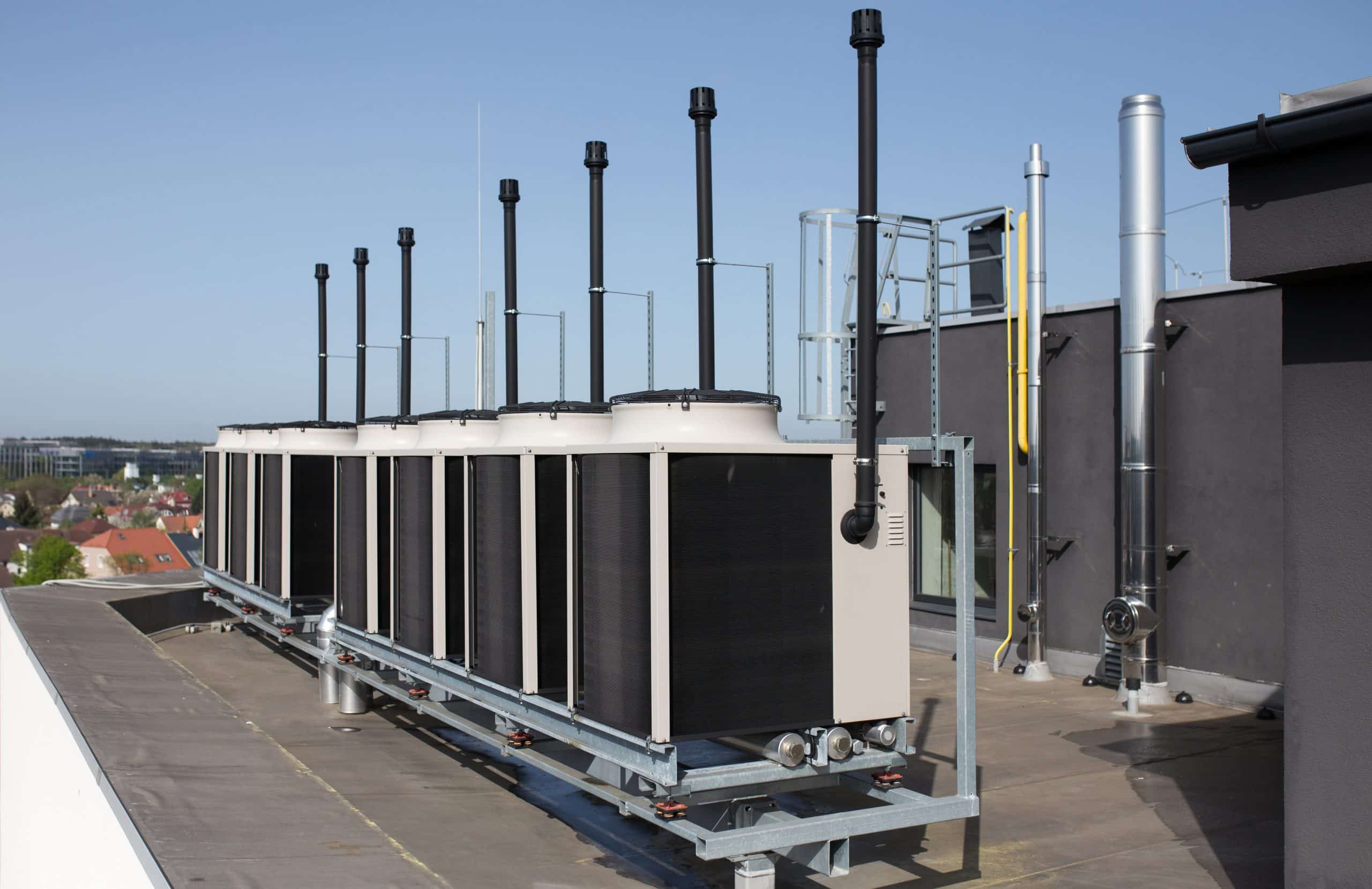
In applications where an electrically powered heat pump might not represent a viable option, gas absorption heat pumps can still deliver significant carbon savings while requiring minimal infrastructure upgrades. Garry Broadbent explains more.
Commercial gas absorption heat pumps (GAHP) have been widely applied throughout the UK, with hundreds of units successfully operating nationally. However, since the electrification of heat and fuel switching from gas have become the industry priority, there has been an increasing focus on electrically powered heat pumps and direct electric forms of heating. So is there still a place for gas-fuelled heat pumps?
As we get nearer to 2050, a new challenge is introduced. It is now clear that our need for renewable heat increases to accelerate carbon reduction and meet government targets. This is where the application of commercial gas absorption heat pumps has emerged with the potential to support the drive to increased renewable heat by simply applying to existing gas use. These hybrid gas renewable heat pumps (GRHP) may be what is required for increased carbon reductions for the foreseeable future.
Upgrading electrical heat pump applications is costly and can be difficult to obtain due to regional or local electricity supply issues, so it is clear that a more transitional approach, rather than immediate fuel switching from gas, can really benefit some carbon reduction-focused applications.
Gas absorption heat pumps are an example of a transitional heat pump opportunity with electrification to follow. This means that lower capital cost carbon reduction measures can be applied immediately via GAHP, and long delays or costs for new electrical supplies can be avoided.
Gas reduction
So what are the benefits of gas absorption heat pumps, and why should they be considered?
Such heat pumps are a simple and straightforward way to apply the use of the incumbent existing gas supply, using approx. 10% of electricity to deliver over 40 kW of heat. So if we have a commercial gas heater which is more than 100% efficient, it is less than 10% electrical to the gas usage when compared to boilers.
Taking the mantra of using less gas rather than no gas, the application of GAHP can make real sense for applications that do not have cost-effective or timely access to increase electrical supplies in order to install electric-powered heat pumps. A modular approach is one possibility, such as using our Robur A-Plus 40 kW units in singular or parallel configuration.
Alternatively, there is the option to specify factory-assembled skids with multiple GAHP units to meet the application. Pure also offers a skid and wiring system, plus there is also the additional option to select a hybrid system with heat pumps and a boiler mounted externally. This option provides a complete hybrid solution by sizing the gas heat pumps to cover the maximum amount of carbon reductions and only bringing the gas boiler into play below an external temperature of, say, 5°C in order to provide additional capacity support.
With respect to current UK demands, the application team at Pure Thermal are confident that the configuration options and case studies within both the UK and throughout Europe will be able to demonstrate correct GAHP application methods to provide confidence to specifiers and designers.
It must be considered that this is not new technology; on the contrary, it is extremely well-established technology with successful application going back over the last 20 years, with GAHP simply being a different type of heat pump refrigeration system to the vapour compression refrigeration system found in an electric heat pump.
How they work
GAHP units utilise a burner to put heat into the refrigeration circuit, unlike the electrical compressor, which does the same job in a vapour compression system; however, both systems utilise the same theory and properties of the renewable energy. In summary, these units use gas to generate heat using renewable source energy, be it air or water, to provide heat that will use circa 40% less gas than the incumbent boiler. Hence, we have a heat pump system which is practical to apply to modular and integrate with existing gas supplies with an output temperature capability of 70°C.
The present unknown situation regarding future gas costs and supply futures is the subject of a government consultation concerning the gas transition launched in November last year. However, when considering the use of gas, it is noted that in Q4 of 2023 a significant investment of circa £150 million was placed by the government into making early creation decisions of the mix to advance the hydrogen-to-natural-gas mix of 9%.
Alongside this, it should also be noted that biogas is gaining further momentum, as is the role of CNG in Spain and Italy, with the agency supplying the grid with clean renewable gas. In summary, the data indicates that the application of gas renewables can be viewed as practical to help deliver carbon-reducing technology for the next 5 to 10 years until more progress is made in the decarbonisation of electricity and more grid availability can be made for electrically powered heat pumps.
There is already a business case that GAHP may be the technology that could be more widely applied to operate for the next 10 years to help create funding through carbon reductions to provide a managed transition to any type of heat pump, and that gas absorption heat pumps are simply another type of heat pump powered by gas rather than electricity.
Specialist heat pump provider Pure Thermal recently relaunched the Italian-manufactured Robur Commercial Gas Absorption Heat Pump back into the UK market as the applied UK partner. Robur first entered the UK market with a GAHP unit in 1993 and has continued to provide a variety of absorption heat pump systems applied in a wide range of sectors. The partnership with Pure Thermal has good synergy with Pure Thermal’s range of specialist cooling units and boilers. The company provides installation, training to specifiers and contractors and support for the operation of GAHP. Several webinars and training sessions are planned throughout Q1 and Q2 this year. Webinars will demonstrate that GAHP are simply just another type of heat pump powered by gas rather than electricity.
Read the full article: EIBI JAN ARTICLE V2